
Cinema lenses are built like precision instruments, because that is what they are. When they are clean, aligned, and correctly lubricated, they reward you with stable focus marks, consistent contrast, and repeatable performance across long shooting days. When they drift, haze, bind, or grow fungus, the footage tells on you fast.
A dedicated lens service centre in the UAE can remove that risk. CINEOM Service Centre supports productions and rental fleets across Dubai, Abu Dhabi, and the wider Gulf and Middle East with workshop-grade inspection, calibration, and repair for virtually any cinema lens you can put on the bench.
A regional service hub built for cinema lenses
The UAE has become a practical base for regional production, and lens support needs to move at the same pace as schedules. A service center that can accept walk-ins locally and coordinate shipping from nearby markets helps keep lenses working, even when sets move quickly between cities and countries.
CINEOM Service Centre is set up to receive lenses from across the UAE and the Middle East, assess them with proper test equipment, and return them ready for set use, not “good enough for now.” That difference matters when you are matching lenses, pulling critical focus, or maintaining a rental inventory that must perform the same way every time it leaves the shelf.
Fast turnaround is valuable, but controlled conditions are non-negotiable. High-end lens work is best done in a clean, dust-managed environment with repeatable optical testing, because a single speck inside a group, or a tiny decentering error, can cost far more than the service itself.
Brands and families we can service, from modern to legacy
Cinema lenses vary wildly in mechanical design, coatings, electronics, and metadata systems. A capable service team recognises what must be handled with brand-specific procedures and what can be restored through universal optical and mechanical best practices.
You can bring cinema primes, zooms, and speciality lenses across leading systems, including Cooke, Angénieux, ARRI, ZEISS, Fujifilm Fujinon, DZOFILM, and high-end sets like Master Primes. The goal is simple: get your lens back to smooth mechanics, accurate marks, clean optics, and reliable performance on a camera test.
After years of regional work, the most common reality is this: lenses rarely fail in just one way. A focus complaint often shows up alongside dust migration, grease breakdown, or a slightly shifted back focus. Proper service treats the system, not only the symptom.
What does “service” mean in a cinema-only workshop
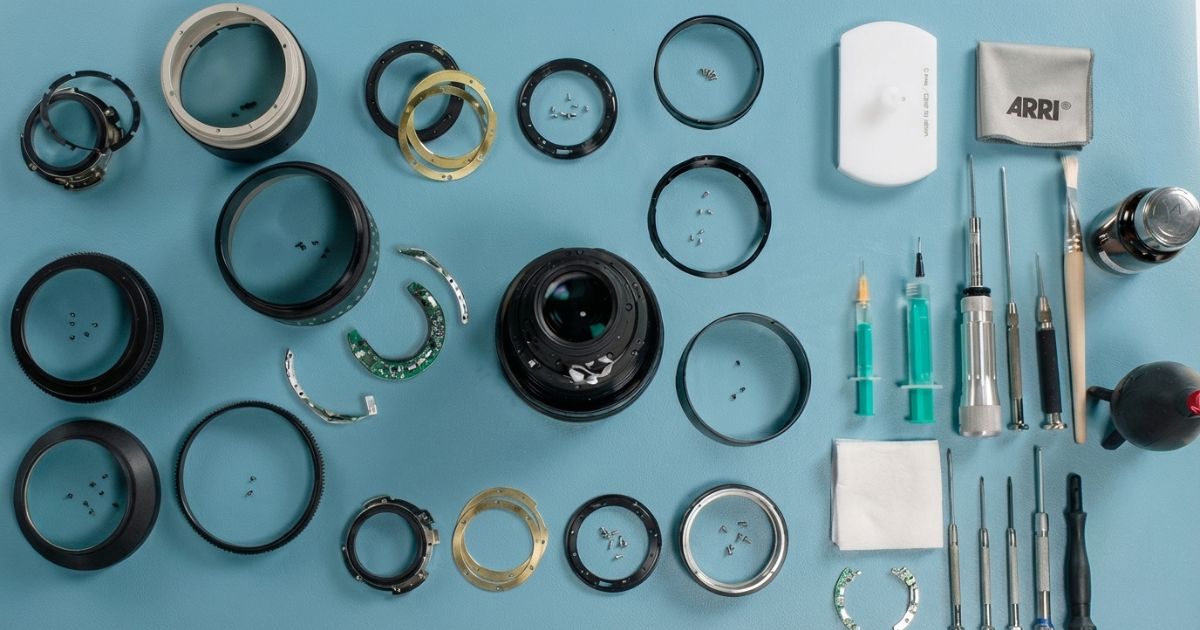
A cinema lens service centre is not a front-element cleaning station. Real servicing is measurement-led: diagnose, disassemble only as needed, restore to spec, then verify on test gear that the issue is gone.
Most jobs fall into one of three categories, and many lenses need a blend of all three:
- Preventive maintenance
- Corrective repair
- Overhaul and re-calibration
The difference is scope, not care. Even a “simple” fungus clean has to be done correctly, because fungus can return if spores remain, and aggressive cleaning can damage coatings faster than the fungus did.
Common issues we fix, from basic to advanced
Lens problems usually show up first on set: inconsistent marks, sticky rings, veiling flare, a sudden softness on one side, or an iris that does not feel right. In the Gulf’s heat, humidity, and dust, those symptoms can appear earlier than crews expect, especially when lenses move between air-conditioned interiors and outdoor locations.
Here are typical issues seen in cinema lenses that a specialist service center can address:
- Fungus and haze removal
- Focus and zoom stiffness
- Back focus and flange distance errors
- Optical alignment and decentering
- Dust, oil, and internal debris
- Iris mechanism issues and inconsistent exposure
- Impact damage, loose groups, worn bearings
- Mount wear, play, or bent components
Many “mystery” complaints come down to calibration. If focus marks do not line up, the issue might be a shifted optical group, wear in the helicoid, an impact that changed spacing, or simply a back focus mismatch with the camera setup. A bench-based approach isolates the cause before parts are touched.
A look at symptoms, likely causes, and typical service actions
The fastest way to reduce downtime is to connect what you see with what the lens needs. The table below outlines common field symptoms and the kind of work that often resolves them.
| Symptom on set | What may be happening | Typical service action |
| Low contrast, milky flare | Haze, coating contamination, internal fogging, fungus | Controlled disassembly, optical cleaning, fungus treatment, re-check transmission and flare behavior |
| Softness on one side of frame | Decentering, shifted group, impact, worn supports | Optical bench testing, element centering, shimming and alignment verification |
| Focus marks inconsistent | Back focus shift, helicoid wear, scale mis-calibration | Collimation, back focus correction, focus scale calibration across distances |
| Focus ring tight or gritty | Grease breakdown, debris, worn bearings | Strip, clean, re-lubricate with suitable damping grease, replace worn mechanical parts |
| Zoom tracking feels uneven | Cam wear, follower issues, lubrication problems | Cam inspection, follower replacement, re-lube, zoom calibration |
| Iris sticky or inconsistent | Blade contamination, mechanical wear, improper assembly | Iris module service, blade cleaning or replacement, aperture calibration |
| Dust specks visible in bokeh highlights | Internal dust migration | Clean-room handling, internal cleaning, sealing checks |
Good servicing ends with verification. A lens is not “done” when it feels smooth in hand. It is done when it projects correctly, holds calibration, and matches expected performance across the image circle.
Why regular service matters in the UAE and the wider Middle East
Environmental stress is real. Heat cycling can change lubrication behavior. Humidity raises fungus risk. Fine dust finds its way past tired seals. Salt air near the coast can accelerate corrosion on exposed components and fasteners.
A routine check, scheduled before the busy season or before a major shoot, often costs less than replacing a single damaged group. It also protects your look. Many cinematographers choose a lens set because of how it renders flare, contrast, and color. Those qualities depend on clean surfaces and stable alignment, not only on the brand name engraved on the barrel.
There is also a business angle. Rental lenses that return from jobs with early signs of wear can be serviced before the next booking. That keeps performance consistent and helps avoid last-minute swaps that disrupt production plans.
Inside the service workflow: from intake to test report
A professional workflow is designed to be predictable for crews and rental operations. While each lens and brand has its own needs, the service path is usually consistent.
A typical service cycle includes:
- Intake and history: Notes on symptoms, recent impacts, storage conditions, and any prior service
- Bench diagnosis: Projection testing, back focus verification, mechanical inspection, metadata checks when relevant
- Estimate and scope: Clear description of what will be done, what parts may be required, and expected timeline
- Repair and calibration: Clean-room handling, correct lubricants, correct torque and assembly practices, optical alignment
- Quality control: Repeat tests, focus scale confirmation, iris checks, final mechanical feel check
- Handover: Secure packing, service notes, and care guidance for storage and transport
This is the difference between a lens that “seems better” and a lens that is measurably back in shape.
Capabilities that separate cinema service from general camera repair
Cinema lenses demand more than careful hands. They demand repeatable measurement.
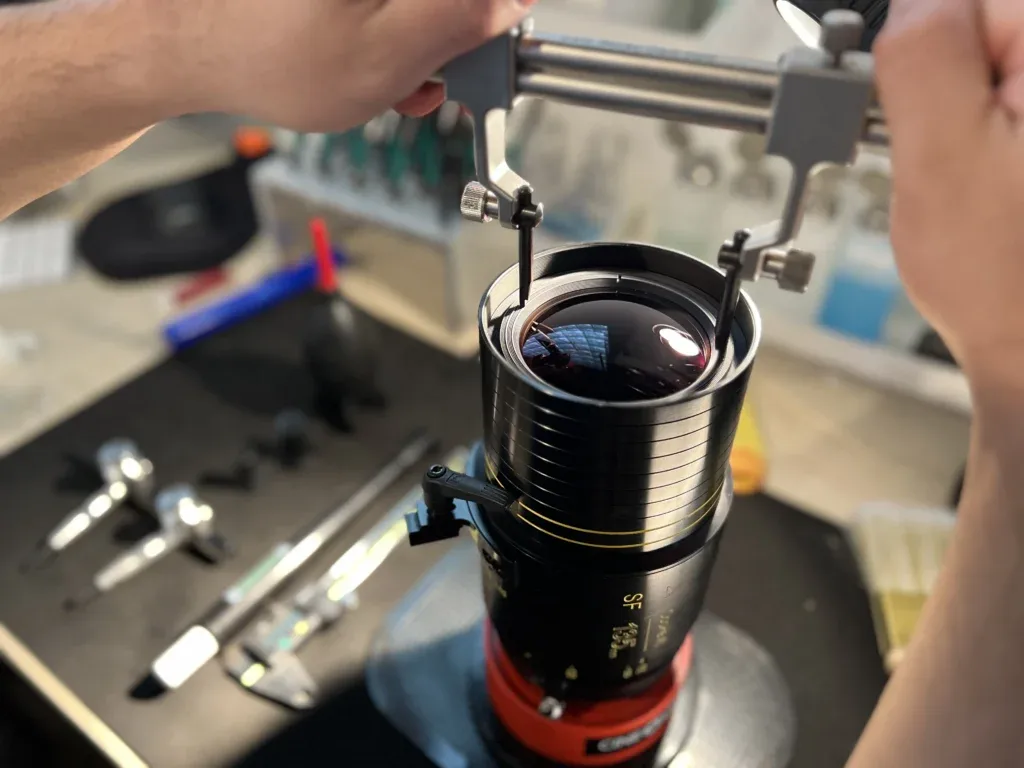
A workshop built for cinema work typically relies on optical benches and collimation tools to set back focus and confirm infinity, plus projection testing to check sharpness behavior, field uniformity, and alignment. Clean air handling matters during assembly, because internal dust is not only cosmetic; it can scatter light and reduce contrast, especially when shooting into sources.
A well-equipped center also keeps the right consumables and parts practices:
- Correct lubricants and damping behavior: Cine focus feel is a design choice, and lubrication must respect that
- Shim and tolerance management: Tiny spacing changes can shift focus or field performance
- Mechanical restoration: Bearings, cams, followers, and rings must return to smooth, repeatable motion
- Coating-safe cleaning: Aggressive solvents or techniques can create permanent damage
Some lenses add electronics and metadata layers. Encoded systems and lens data functions must be checked after mechanical work, because physical alignment and electronic reporting need to agree.
Fungus, haze, and optical contamination: fixing the problem and stopping the return
Fungus is common in hot and humid conditions, especially when lenses are stored closed up after night shoots, transported between climates, or left in cases without dry control. Early fungus can look like faint webbing or tiny spots. Left alone, it can etch coatings and mark glass permanently.
A proper fungus service is a controlled process: identify affected surfaces, treat and remove contamination safely, clean without harming coatings, and then check for any remaining residue or damage. After the lens is restored, storage habits decide whether the problem stays solved.
A few practical habits reduce repeat occurrences:
- Store lenses in a dry cabinet or case with active humidity control
- Avoid sealing a warm lens in a case right after humid exterior work
- Keep caps, pouches, and cases clean and dry, since they can carry spores
Serving productions across the UAE and the Gulf
Whether you are a working cinematographer, a production company, or a rental operation, the goal is the same: lenses you trust.
CINEOM Service Centre supports customers across the UAE and the Middle East with on-site workshop services for cinema lenses from Cooke, Angénieux, ARRI, ZEISS, Fujifilm Fujinon, DZOFILM, and more. Bring in any cinema lens with a basic or advanced issue, and the team can diagnose it properly, clearly explain the repair path, and return it calibrated for real shooting conditions.
If a lens is already showing signs of fungus, focus drift, uneven sharpness, stiff movement, or any other mechanical fault, booking the service early keeps your schedule intact and your images consistent.