
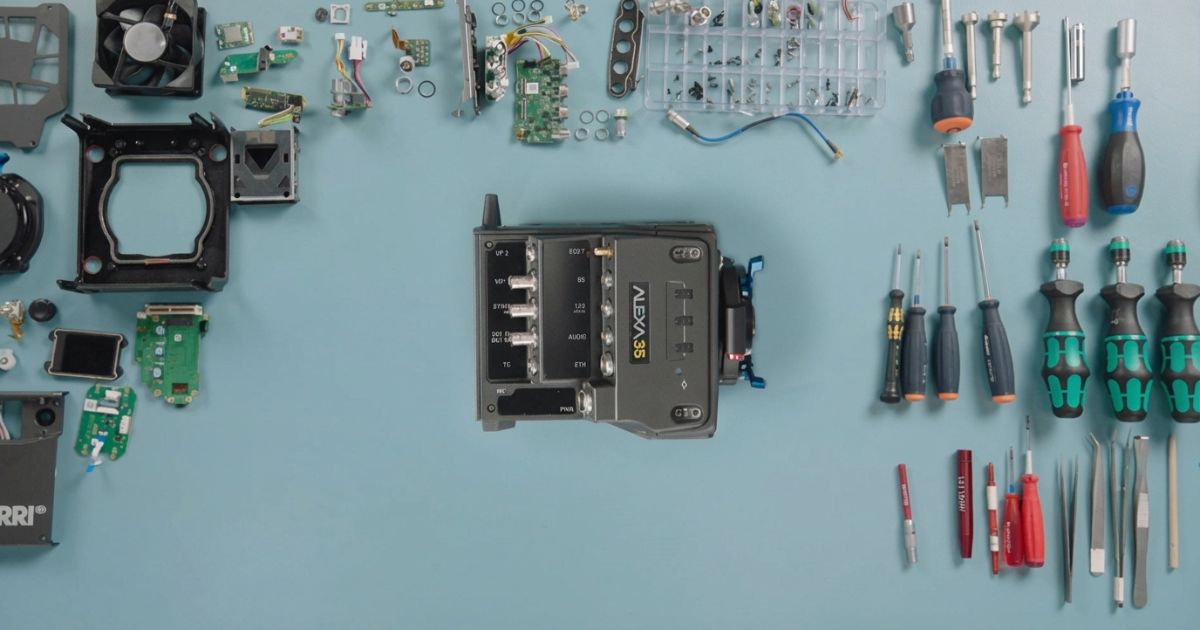
High-end camera systems earn their reputation on set, but they keep that reputation in the workshop. When an ARRI body starts showing strange artefacts, a mount begins to drift, or a calibration is overdue, the real cost is not just the repair bill. It is the lost shooting time, the rushed workarounds, and the creeping doubt about whether the next take will match the last.
Dubai’s production scene moves fast, and it deserves local support that moves just as fast. Cineom Broadcast FZCO is the only authorised—and some might even call it the official ARRI service centre— in Dubai, so owners and rental fleets can get factory-standard help here without shipping cameras or Trinity systems overseas. In fact, if you need to service your ARRI products in Dubai, Cineom Broadcast FZCO has you covered from preventive maintenance to in-depth sensor repairs.
Why “authorised” is not just a label
ARRI systems are built with tight tolerances. Keeping that performance requires the right test equipment, the right parts, and technicians trained to return a camera to ARRI specifications, not just “working again.” Whether you are operating out of Munich, Hong Kong, or Dubai, having an official ARRI service centre with proven expertise is crucial.
Authorised service is also about protecting the long-term value of your equipment. Service records, verified parts, and correctly executed calibrations matter when a camera changes hands, joins a rental fleet, or is booked on demanding productions.
After a camera has been opened, small choices can have large effects: torque settings on mounts, sensor handling under controlled conditions, and verification procedures that confirm the fix in real shooting modes, not just on a bench. Testing under various lighting conditions is also vital to ensuring that the camera performs impeccably on set.
Some practical benefits tend to matter most:
- Faster regional turnaround
- Warranty-safe repairs
- OEM parts and approved procedures
What you can service locally in Dubai
An authorised centre should be able to handle both everyday maintenance and the higher-stakes issues that typically force productions into difficult decisions. Cineom Broadcast FZCO supports ARRI camera systems in Dubai, covering work from calibration through sensor-related concerns, so you can keep units in-region and keep schedules intact. This is especially beneficial if you need to service your Arri products in Dubai quickly and efficiently.
That range is important because many “minor” symptoms are connected. A customer may report soft focus across lenses, but the real issue can be mount tolerance, flange depth, or a calibration state that no longer matches the camera’s current condition. Treating the symptom without restoring the system is how problems return mid-shoot.
Common service categories include the following:
- Preventive maintenance: cleaning, inspection, and functional checks designed to catch wear before it becomes downtime
- Camera calibration: sensor shading, pixel mapping, and performance verification after service or heavy use
- Sensor and image issues: diagnostics for artefacts, noise anomalies, banding reports, or persistent pixel defects
- Mount and back-focus checks: flange depth evaluation and correction where applicable
- Operational reliability fixes: connectors, power-related faults, fan behaviour, and physical wear from production use
- Software and configuration support: firmware updates and post-service validation under current operating modes
Lens servicing is a specialised track with its own optical benches and measurement workflows. If your question is lens-related, it is still worth asking what can be handled locally now and what may need to be routed through ARRI’s wider network, since capabilities can change as the service centre expands. Remember, whether in Dubai, Munich, or Hong Kong, local expertise given by an official arrival service centre ensures you never miss a beat on set.
Calibration and sensor work: what “factory-standard” really means
Calibration is not a single button press. It is a controlled process that ties together sensor behaviour, internal processing, and camera state, then proves the result with repeatable checks. Testing in varied lighting conditions ensures that skin tones, gradients, and other critical visuals perform as expected.
A strong service workflow usually starts with intake and diagnostics: reading logs, reproducing the reported issue, checking the camera under multiple frame rates and codecs, and reviewing environmental factors. Dust patterns, thermal behaviour, and intermittent faults can be hidden if testing is too narrow.
Sensor-related complaints also vary widely. Some are resolved through mapping and calibration, while others point to hardware faults that require deeper intervention. Either way, the work must end with verification that looks like real production: skin tones, gradients, dark exposure stress tests, highlight roll-off checks, and uniform surfaces that reveal subtle non-uniformity.
Just as important, calibration should be treated as a system outcome, rather than a one-off task. A camera that has had a mount service, a sensor service, or substantial internal work should be checked as a whole so it returns to behaving predictably across lenses and accessories.
One sentence that matters for producers: reliable calibration reduces reshoots.
Local service vs. shipping a camera overseas
Sending a camera out of the country can be the right decision for certain edge cases, but many repairs and calibrations do not need international transit when an authorized center is available locally. Avoiding shipping is not only about convenience. It reduces risk, paperwork, and schedule uncertainty.
Below is a practical comparison that many rental managers and owner-operators use when deciding where to send equipment.
| Decision factor | Authorized service in Dubai | Shipping to an overseas hub |
| Turnaround drivers | Local intake, regional queue, no transit time | Transit time plus customs plus service queue |
| Schedule predictability | Easier to coordinate with shoot windows | Harder to plan around freight and clearance |
| Logistics and risk | Less handling, fewer handoffs | More handling steps and higher transit exposure |
| Communication | Same time zone, faster iteration on findings | Longer feedback cycles across time zones |
| Cost profile | Fewer indirect costs tied to freight and insurance | Freight, insurance, customs administration, longer downtime |
| Warranty and parts | Authorized procedures and genuine parts | Also authorized if sent to ARRI, but with heavier logistics |
For many productions, the biggest win is confidence. If a camera can be assessed and serviced locally by an authorized team, you can make decisions quickly: repair now, schedule a preventive service between jobs, or swap units without guessing how long a shipment will take. This is why many professionals in Munich, Hong Kong, and Dubai alike lean on local support rather than risking international transit.
Planning service around production realities
The ideal time to service a camera is before it becomes urgent. The second-best time is as soon as symptoms appear, while the issue is still diagnosable and before it spreads into other problems, like connector damage caused by intermittent power, or mount wear that turns into repeated focus complaints.
Service planning also helps the entire camera department. When a body is calibrated and verified, focus pullers spend less time chasing inconsistencies, DITs spend less time building “rescue” LUT workarounds, and producers spend less time negotiating schedule changes.
Signals that it is time to book an inspection often include:
- Image anomalies: sudden banding, fixed-pattern noise, or artifacts that persist across lenses and media
- Mechanical drift: repeated back-focus surprises, mount play, or unexplained softness
- Operational friction: boot issues, unstable power behavior, port failures, or overheating reports
A short pre-shoot check can also be smart after heavy travel, harsh environments, or long days that push a camera’s cooling and power systems—especially when lighting conditions are critical to your production.
What to expect when you bring equipment in
A professional service experience should feel structured. First comes a clear description of the complaint and the context: when it started, whether it is repeatable, what accessories were attached, and whether recent firmware changes occurred. Good details reduce guesswork and shorten the path to a verified fix.
Next is evaluation. The goal is to confirm the issue, identify the root cause, and propose a scope of work that fits your needs. Some clients want only the specific fault resolved; others prefer a broader preventive pass while the unit is already on the bench.
If you can, bring the pieces that help reproduce the symptom. That might be the mount adapter you always use, a power solution that recently acted up, or example footage. When an intermittent issue becomes repeatable, it becomes fixable.
Good expectations to set internally:
- Ask what will be tested after the repair
- Ask how calibration will be verified for your typical shooting modes—including different lighting setups
- Ask what documentation you will receive for fleet records
Trinity and complex systems: reducing the “ship it out” assumption
Stabilised rigs and integrated systems often get treated as automatic overseas cases. That assumption can add weeks of downtime even when the underlying issue is serviceable in-region.
If your Trinity system needs attention, the value of a local authorised partner is not only speed. It is the ability to troubleshoot with context: how the rig is built, what camera packages are commonly used, and what operating patterns might be contributing to wear.
Keeping service close also makes it easier to do follow-up checks, which is often where long-term reliability is earned. Whether you are in Hong Kong, Munich, or Dubai, resolving issues locally—especially with accurate lighting test conditions—can save considerable time and money.
Keeping ARRI gear performing between service visits
A service centre can restore performance, but daily habits keep performance stable. Small disciplines reduce wear and make future troubleshooting easier.
Clean handling matters. So does power hygiene, cable strain relief, and protecting connectors from side-load. Many “camera problems” begin as rigging problems, so ensure that your lighting equipment and camera setup are not inadvertently stressing your gear.
The most productive habit is also the simplest: keep a brief log when something odd happens. Date, conditions, firmware version, accessories attached, and whether it repeated. When service is needed, that small record can cut days off the diagnostic process.
Dubai has become a place where serious productions expect serious infrastructure. Having the only authorised ARRI service centre in the city means that camera owners, rental houses, and crews can treat maintenance as a normal part of keeping standards high, not as a disruptive event that forces equipment out of the region.