
The Studio Design Dilemma: Why Most Projects Fall Short of Expectations
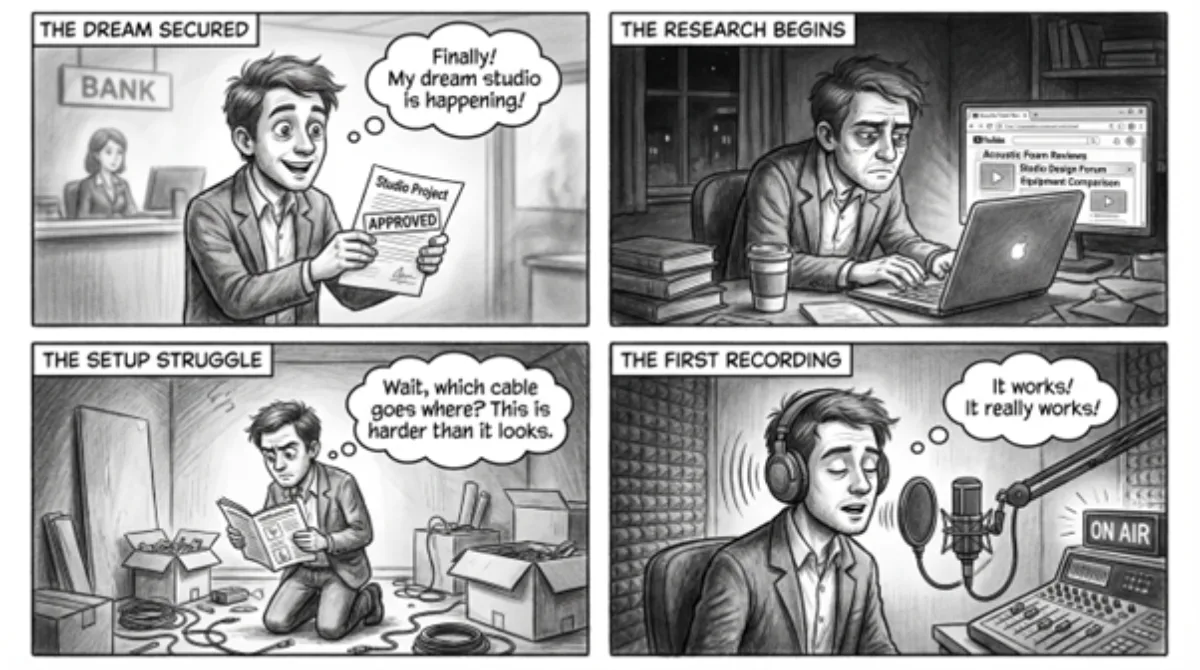
Picture this: You’ve secured funding for your dream studio. You’ve spent countless hours watching YouTube tutorials about acoustic treatment, scrolling through equipment forums, and collecting quotes from different vendors. You’re drowning in technical specifications, conflicting advice, and the gnawing worry that one wrong decision could derail your entire investment.
You’re not alone.
The truth is, designing a professional audio or video production facility is exponentially more complex than selecting the right microphone or DAW. It’s a multidimensional puzzle where acoustics, ergonomics, signal flow, power distribution, future scalability, and workflow psychology must harmonise seamlessly. A spectacular SSL console means nothing if it’s sitting in a room plagued by flutter echoes and resonant modes. The latest Dolby Atmos monitoring system becomes a liability if speaker placement violates fundamental psychoacoustic principles.
This is where the overwhelming majority of studio projects stumble – not from lack of passion or budget, but from the absence of integrated, holistic expertise.
Enter Cineom Broadcast FZCO
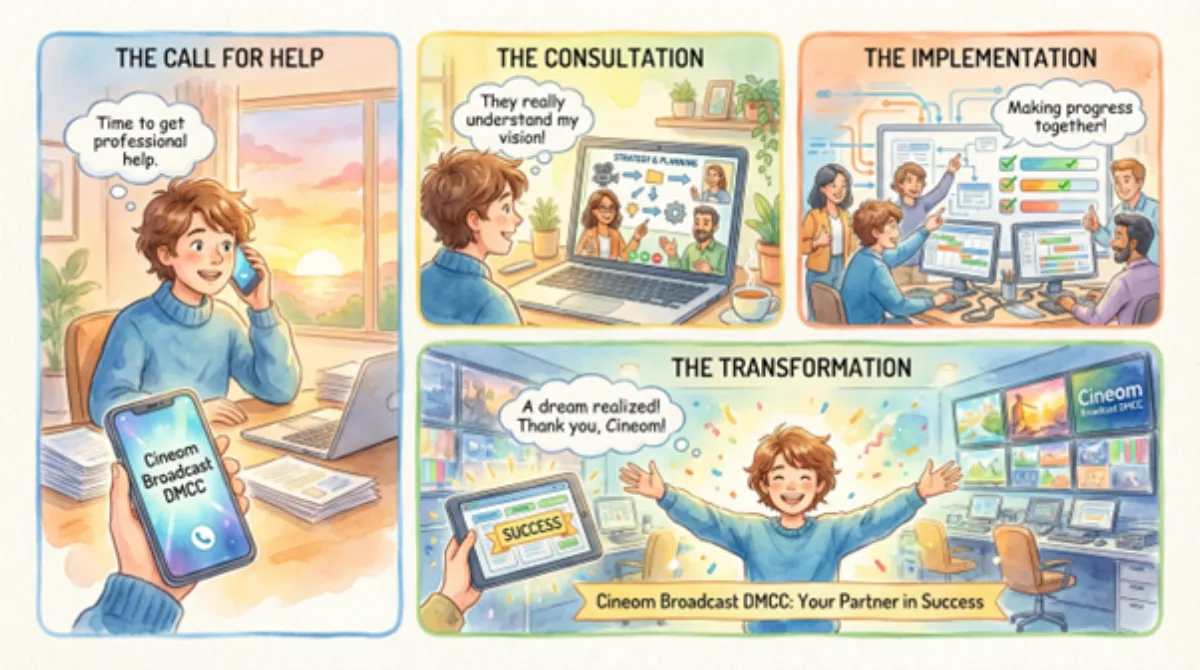
As a premier system integrator specialising in end-to-end studio design, Cineom doesn’t just supply equipment—we architect complete creative environments. We translate your artistic vision into acoustically optimised, workflow-efficient realities that blend the warmth of analogue heritage with the boundless possibilities of digital innovation. From initial concept sketches to final calibration measurements, we streamline the entire design process, transforming what could be a chaotic nightmare into a smooth, rewarding journey.
This comprehensive guide demystifies professional studio design and reveals how Cineom’s methodical approach, acoustic mastery, and deep industry partnerships create facilities that don’t just meet specifications – they inspire greatness.
Cineom’s holistic studio design expertise: Where acoustics, workflow, and technology converge
The Cineom Difference: Beyond Just Equipment Suppliers
A Holistic Approach to Studio Environments
The audio and broadcast industry is littered with cautionary tales: beautiful studios that sound terrible, expensive facilities with inefficient workflows, “state-of-the-art” installations that become obsolete within three years. These failures share a common root cause—they were built through fragmented procurement rather than integrated design.
Cineom Broadcast FZCO operates on a fundamentally different philosophy.
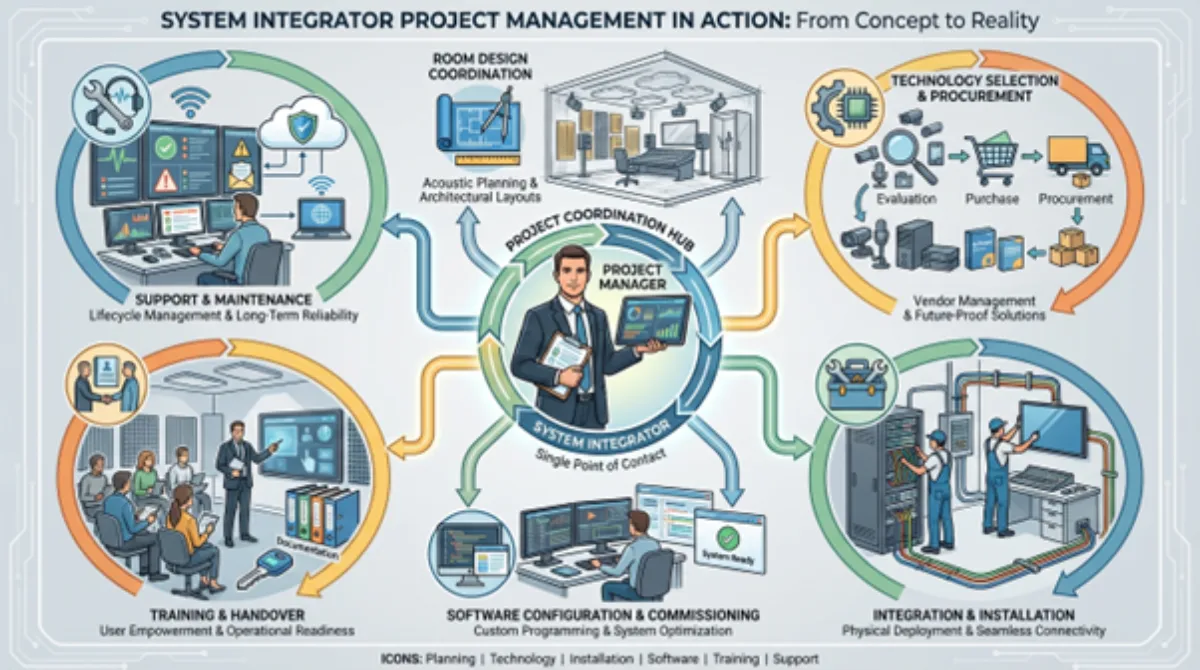
We don’t see ourselves as equipment vendors. We’re studio environment architects, acoustic engineers, workflow consultants, and technology integrators rolled into one cohesive team. When you engage Cineom, you’re not purchasing a collection of gear—you’re commissioning a complete, optimised creative instrument.
This distinction matters profoundly. A piecemeal approach might get you an AMS Neve console here, some Genelec monitors there, and acoustic panels from wherever offers the best price. But who ensures that the monitor’s frequency response complements your room’s acoustic signature? Who designs the signal routing to minimise latency while preserving analogue character? Who plans the monitor placement to achieve an accurate centre image (Sweet Spot ) at the mix position?
The answer: A dedicated system integrator with end-to-end expertise.
Acoustical Mastery: The Foundation of Sonic Truth
Let’s address the elephant in every studio: acoustics are everything.
You can own the most exquisite microphone collection ever assembled, the most transparent preamps, the most powerful DAW workstation—and still produce mediocre results if your room is working against you. Conversely, even modest equipment sounds remarkable in a properly treated acoustic space.
Why? Because your monitoring environment is your reference reality. Every mixing decision you make—EQ choices, compression settings, reverb amounts, panning positions—is filtered through your room’s acoustic response. If your room has a 6dB peak at 120Hz, you’ll unconsciously mix with less bass, and your mixes will sound thin everywhere except your untreated studio. If standing waves create massive nulls at your listening position, you’ll never achieve accurate low-frequency balance.
Professional acoustic design isn’t optional—it’s the prerequisite for professional results.
Cineom’s Acoustic Engineering Expertise
Our approach to acoustics combines scientific rigour with decades of practical experience:
Sound Isolation & Structural Design
We begin by analysing your facility’s structural characteristics and isolation requirements. Are you in a commercial building with adjacent tenants? A residential area with noise ordinances? Our team calculates the necessary STC (Sound Transmission Class) ratings and designs multi-layer isolation strategies—decoupled walls, floating floors, isolated ceilings—to ensure your loudest recording sessions don’t become legal liabilities.
Room Mode Analysis & Management
Every rectangular room has inherent resonant frequencies determined by its dimensions—these are called room modes or standing waves. At certain frequencies, sound pressure builds up dramatically; at others, it virtually disappears. We use sophisticated acoustic modelling software to identify these problematic frequencies before construction begins, then employ strategic room ratios, bass-trapping placement, and, when necessary, subtle architectural modifications to minimise their impact.
Flutter Echo Elimination
Parallel reflective surfaces create the dreaded “boing” effect that smears transients and ruins clarity. Our designs incorporate calculated angles, diffusion surfaces, and strategic absorption to eliminate these artefacts while maintaining the room’s sense of space and air.
Precision Absorption & Diffusion
This is where science meets art. Too much absorption creates a lifeless, fatiguing space. Too little creates a chaotic mess of reflections. We calculate absorption coefficients across the frequency spectrum and design custom treatment schemes—broadband absorbers for low-frequency control, mid-frequency panels to reduce RT60, and strategically placed diffusers to maintain acoustic liveliness—that create what acousticians call a “fast” room: quick decay times that reveal detail without sterility.
Speaker Placement & Calibration
Monitor positioning might be the most critical—and most neglected—aspect of studio acoustics. We employ the time-tested equilateral triangle principle as a starting point, then refine placement using measurement microphones and acoustic analysis software. We account for SBIR (Speaker Boundary Interference Response), the phenomenon where sound waves reflecting off nearby surfaces interact with direct sound to create comb filtering. Our calibration process includes:
- Time alignment between drivers and subwoofers
- Phase coherency verification
- SPL matching across all channels (critical for immersive audio formats)
- Precise RT60 (Reverberation Time) measurements and adjustments
- Frequency response optimisation through a combination of physical treatment and minimal DSP correction
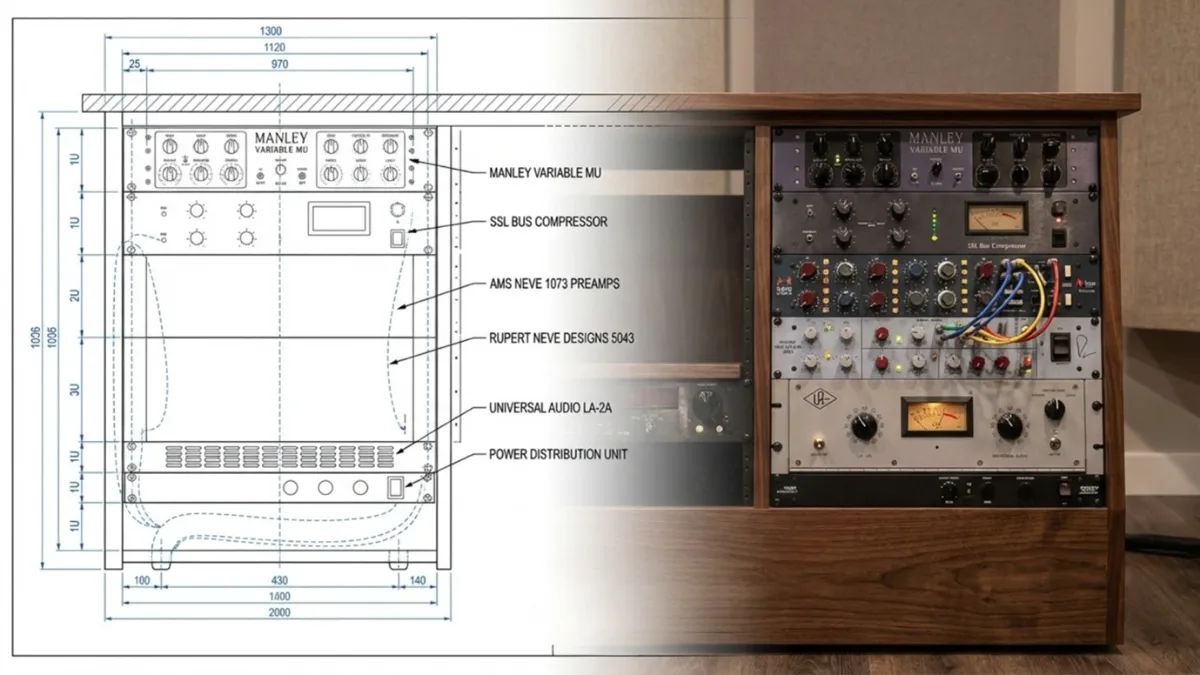
- Hand-sketched acoustic panel designs and technical furniture layouts—where precision meets artistry
Learning from Legends: Acoustic Principles in Iconic Studios
Our approach isn’t theoretical—it’s informed by the successes of the world’s finest facilities.
Consider Abbey Road Studios’ Studio Two in London, where The Beatles recorded their most influential work. The room’s controlled reflections and custom-designed ceiling diffusers create what engineers describe as a “musical” acoustic signature—revealing enough for critical decisions yet forgiving enough for creative experimentation. When EMI rebuilt the facility in the 1990s, they meticulously preserved these acoustic characteristics, recognising that the room itself had become an irreplaceable instrument. Cineom applies similar principles: we design rooms that complement rather than fight the creative process.
Capitol Studios’ Studio A in Los Angeles presents another masterclass in acoustic design. Its unique echo chambers—large reverberant rooms connected to the control room via speakers and microphones—provide natural reverberation impossible to replicate digitally. While we may not build dedicated echo chambers for every project, the underlying principle guides our work: acoustic spaces should enhance and expand creative possibilities. We design rooms with specific sonic signatures when appropriate, or with absolute neutrality when transparency is paramount.
Blackbird Studio in Nashville, designed by George Augspurger, demonstrates the importance of low-frequency low frequencies. Studio A features massive bass traps hidden behind fabric-covered walls, sophisticated tri-corner traps, and carefully calculated room dimensions that minimise modal problems. The result? A room where bass decisions translate accurately to any playback system. Cineom employs similar rigorous bass management strategies, recognising that low-frequency accuracy remains the greatest challenge—and greatest opportunity—in acoustic design.
AIR Studios in London, founded by Sir George Martin, showcases the value of variable acoustics. The main studio features movable acoustic panels and curtains that allow engineers to adjust the room’s character for different projects—livelier for orchestral recordings, deader for vocal isolation. While not every facility needs this level of complexity, the concept informs our approach: we design flexibility into systems wherever budget allows, ensuring your studio can adapt to evolving creative needs.
The common thread through these legendary facilities? Acoustic design wasn’t an afterthought—it was the foundation upon which everything else was built.
Cineom Broadcast FZCO brings this same philosophy to every project, whether you’re building a modest dubbing suite or a world-class Dolby Atmos mixing theatre. We understand that great acoustics aren’t just about measurements and calculations—they’re about creating spaces that facilitate creative flow, reduce listener fatigue, and ensure that the decisions made in your studio translate accurately to the outside world.
Workflow Design: The Heartbeat of Efficiency
Spectacular acoustics and premium equipment mean little if your daily workflow involves constant cable swapping, confusing signal routing, or productivity-killing technical friction.
This is where Cineom’s workflow design expertise transforms good studios into great ones.
The Art of “Crazy Workflows”
We affectionately call them “crazy workflows”—not because they’re chaotic, but because they’re simultaneously sophisticated and intuitive, handling complex routing scenarios with elegant simplicity. These are systems where:
An engineer can seamlessly switch between tracking a live band, recording ADR, mixing in surround, and monitoring Atmos content—without re-patching a single cable
Analogue and digital signal paths coexist harmoniously, with hybrid routing that leverages the strengths of each domain
Collaboration features are built in, allowing producers in the lounge to hear the mix, directors to communicate with talent in voice-over booths, and remote clients to join sessions via high-quality streaming
Redundancy is invisible but ever-present, ensuring that shows go on even when equipment fails
Analogue & Digital Harmony: The Best of Both Worlds
There’s a persistent myth in audio circles: you must choose between analog purity and digital convenience. Engineers are supposedly divided into tribal camps—analog purists clutching their tape machines and transformer-coupled gear, versus digital natives who’ve never touched a fader without motor automation.
Cineom rejects this false dichotomy entirely.
The most inspiring studios we design embrace hybrid workflows that extract maximum value from both approaches:
The Analog Advantage
Certain elements of the signal chain remain superior in the analog domain:
Console summing through high-quality analog busses (SSL, AMS Neve) imparts a cohesive “glue” and three-dimensional imaging that even the best ITB mixing struggles to replicate
Outboard compression and EQ from legendary manufacturers like Manley, Universal Audio, and GML offer harmonic complexity and tactile control that inspire creative decisions
Analog monitoring paths provide zero-latency confidence monitoring during tracking, critical for capturing optimal performances
Tactile, physical control surfaces with real faders and knobs facilitate faster, more musical mixing than mouse-based DAW control alone
The Digital Powerhouse
Simultaneously, modern digital workflows provide capabilities that would be impossible (or prohibitively expensive) in pure analog:
Non-destructive editing and unlimited undo states encourage creative experimentation
Total recall of every parameter, allowing you to return to any mix state instantly
Plugin processing that would require a warehouse full of outboard gear to replicate
Immersive audio production for Dolby Atmos and other object-based formats that simply cannot exist in analog-only domains
File-based collaboration enabling remote work, simultaneous editing, and version control
Integration with video for post-production workflows requiring frame-accurate sync
Real-World Hybrid Scenarios
Let’s examine how Cineom designs integrate both worlds:
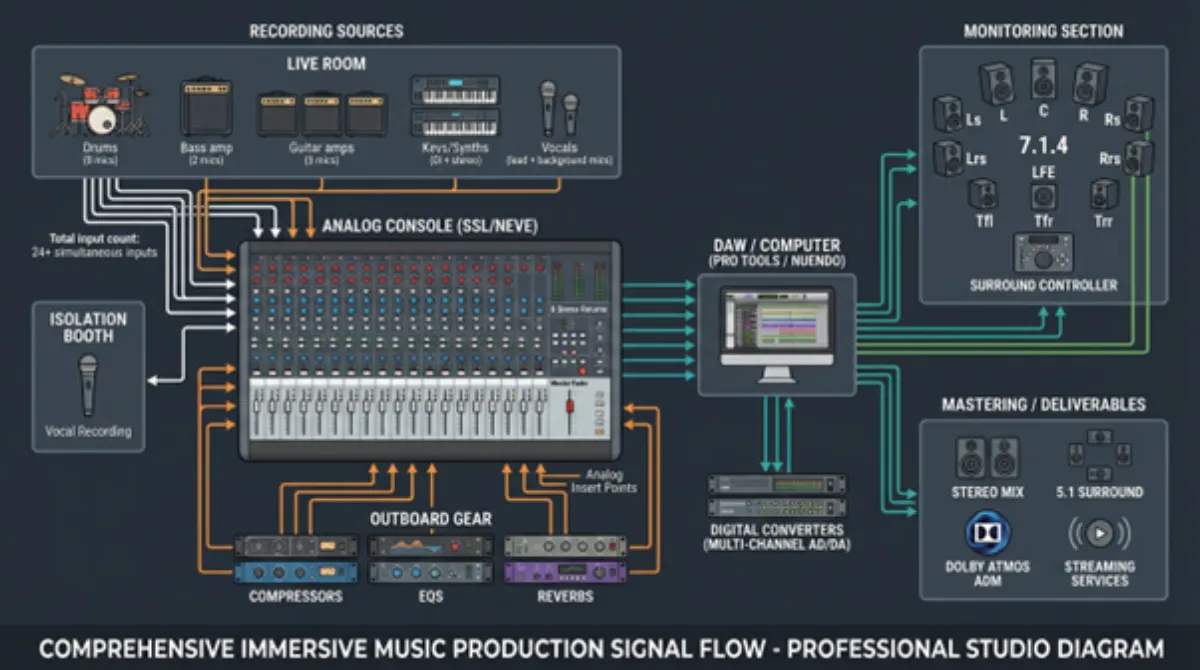
Music Tracking & Mixing Hybrid:
Track live instruments through high-quality analog preamps and an SSL console, capturing the warmth and immediacy of analog signal paths. Simultaneously record into Avid Pro Tools for editing flexibility. During mixing, send individual Pro Tools outputs through the console for analog summing, while using the DAW for automation, plugin processing, and recall. Insert critical outboard compressors and EQs on vocal busses and master chain. Result: the warmth and dimension of analog summing combined with the flexibility and recall of digital mixing.
Film Post-Production Flow:
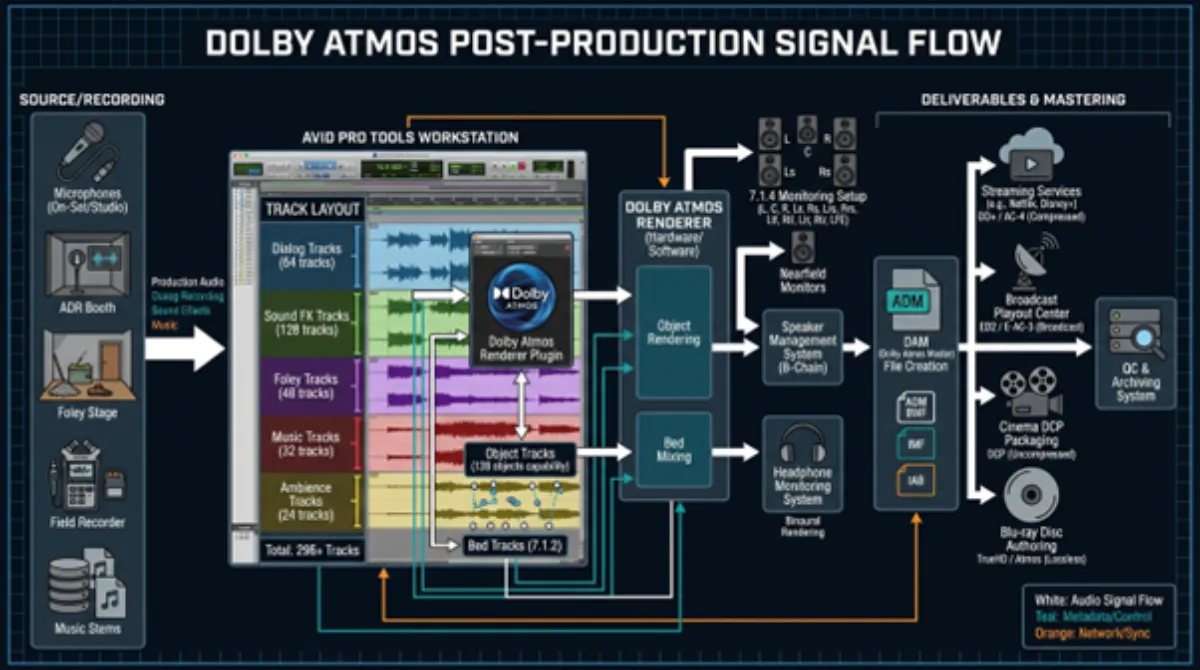
Design a system where dialogue, Foley, and ADR recording happen through pristine analog chains for maximum fidelity and zero-latency monitoring. Import into Pro Tools for editing, noise reduction, and object placement in Dolby Atmos Renderer. Route final stems through an analog monitoring chain (bypassing D/A/D conversion stages) for theatrical calibration and quality control. Deliver digitally in multiple formats. Result: clinical editing precision married to analog monitoring accuracy.
Broadcast Production Environment:
Create a facility where live talent can be mic’d through traditional analog broadcast consoles with hardware processing for “radio-ready” sound, while simultaneously feeding digital multitrack recording for archival and podcast distribution. Use analog routing for zero-latency headphone mixes and on-air monitoring, while digital systems handle streaming encoding, automated playback, and content management. Result: the reliability and tactile control broadcasters demand, with modern digital distribution capabilities.
Complex Avid Pro Tools workflow for Dolby Atmos film mixing—where hundreds of tracks meet sophisticated routing
The key to successful hybrid design is seamless integration. Cineom engineers these systems so that format conversion, routing, and monitoring are invisible to the operator. You focus on creative decisions; the infrastructure handles the technical complexity automatically.
Tailored for Every Creative Need: From Mono to Immersive Audio
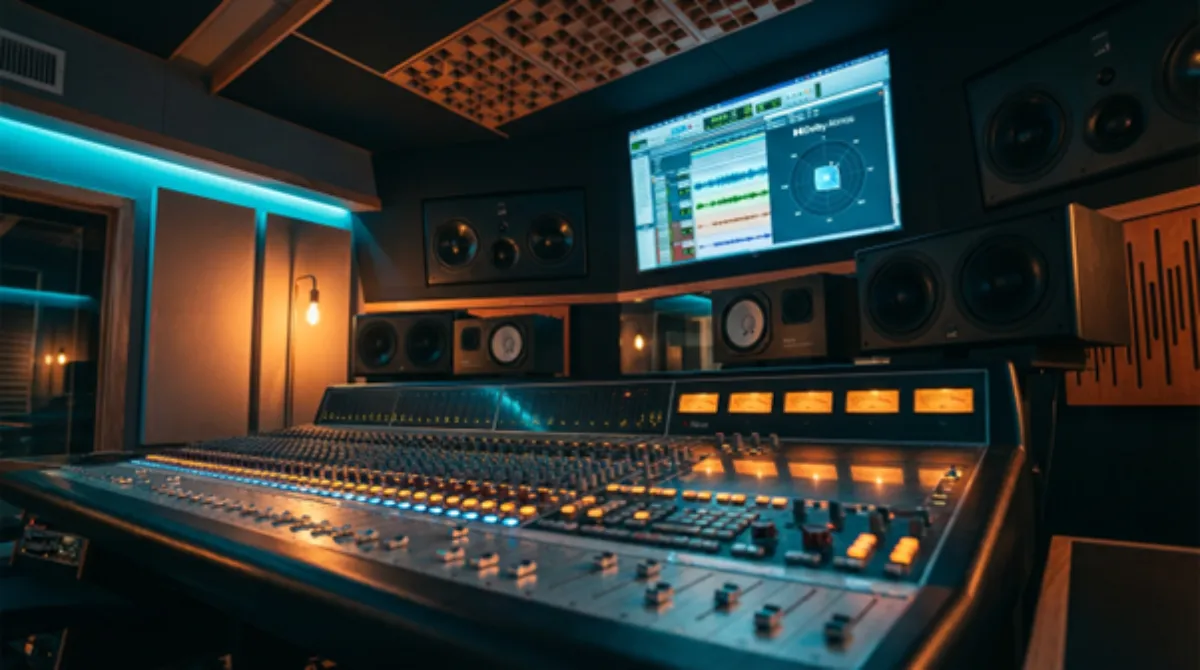
One size has never fit all in professional studio design.
A music producer crafting intimate singer-songwriter albums has completely different requirements than a film mixer delivering theatrical Dolby Atmos content. A broadcast dubbing facility needs instant access to hundreds of sound effects and seamless communication with talent, while a mastering studio demands the most revealing monitoring environment possible and minimal signal-path colouration.
Cineom Broadcast FZCO designs facilities across the entire spectrum of audio and video production:
Music Production & Recording Studios
- Whether you’re building an intimate writing room or a full-scale tracking facility capable of capturing orchestral sections, our designs prioritise:
- Acoustic environments that complement musical genres (controlled reflections for rock/pop energy, absolute neutrality for acoustic/classical precision)
- Flexible monitoring from near-field reference to large-format soffit-mounted main monitors
- Hybrid signal paths optimising both tracking immediacy and mixing flexibility
- Comfortable, inspiring spaces where artists and engineers want to spend extended sessions
Audio Dubbing Facilities
Dubbing studios demand unique capabilities:
- Pristine vocal isolation with carefully designed voice-over booths featuring optimal RT60 for speech intelligibility
- Seamless talent communication via talkback systems and video monitoring
- Efficient ADR workflows with streamlined recording, editing, and conforming
- Multi-language capabilities and quick session turnaround
Music Mixing Suites
- Mixing rooms are where final creative decisions happen, requiring:
- Absolute acoustic accuracy with controlled reflections, managed low frequencies, and precise monitor calibration
- Extended monitoring paths supporting multiple speaker sets for perspective checking
- Ergonomic furniture design , placing all critical controls within arm’s reach during long sessions
- Hybrid analog/digital signal flow maximising both sonic quality and workflow efficiency
Film Mixing & Foley Stages
- Cinematic audio post-production presents some of the most complex requirements:
- Immersive audio capabilities for Dolby Atmos, Auro-3D, or DTS:X formats
- Video projection systems with proper viewing geometry and calibrated color spaces
- Sophisticated routing matrices handling hundreds of tracks across dozens of busses
- Foley pit design with multiple surface types and isolation from control rooms
- Layback and quality control systems ensuring deliverables meet theatrical standards
Post-Production Suites (All Formats)
Modern post-production facilities often need to handle diverse content types:
- Multi-format delivery supporting everything from stereo podcasts to Atmos theatrical mixes
- Integrated picture workflows with high-resolution reference displays and calibrated viewing environments
- Collaboration infrastructure for director/producer feedback and remote client participation
- Archival and asset management systems for organizing complex projects across long timelines
Immersive Audio Expertise: Beyond Stereo
- The future of audio is dimensional.
- Whether you’re delivering content for theatrical release, streaming platforms, gaming, or even automotive premium audio systems, immersive formats like Dolby Atmos are rapidly becoming the expected standard rather than a luxury option.
- Cineom Broadcast FZCO brings deep immersive audio design expertise spanning:
- Traditional Surround Formats:
- 5.1 (Film & Television Standard): Six channels providing front soundstage, surround ambience, and discrete LFE for cinematic impact
- 7.1 (Enhanced Cinema & Home Theater): Adds rear surrounds for improved spatial envelopment and smoother pans
- 9.1 (Rare, Experimental): Additional wide channels for ultra-wide soundstage applications
Height-Enabled Immersive Formats:
Dolby Atmos (Theater & Consumer): Object-based format supporting up to 128 simultaneous audio tracks and 64+ speaker outputs, with overhead channels creating true three-dimensional soundscapes
- 9.1.2 Configuration: Nine bed channels plus two height channels, representing a practical minimum for compelling Atmos content creation
- 7.1.4 Configuration: Seven bed channels plus four height channels, offering excellent immersive reproduction for mid-sized facilities
- Custom configurations: Scaled to room size and content requirements, from compact 5.1.4 nearfield setups to expansive 9.1.6 theatrical environments
Why does immersive audio matter for your facility?
- Content Differentiation: Immersive mixes provide a competitive advantage in crowded content markets
- Platform Requirements: Major streaming services (Netflix, Apple Music, Disney+, Amazon) increasingly prefer or require Atmos deliverables
- Creative Expression: The height dimension opens entirely new storytelling possibilities—rain falling from above, helicopters passing overhead, emotional emphasis through vertical space
- Future-Proofing: As consumer playback systems (soundbars, wireless speakers, automotive audio) adopt immersive decoding, stereo-only content becomes increasingly dated
- Backward Compatibility: Properly crafted Atmos mixes fold down gracefully to all traditional formats through automated rendering
Designing an immersive audio facility requires specialized expertise beyond traditional stereo or surround studios:
- Geometric precision: Speaker placement angles, distances, and heights follow strict specifications; even small deviations degrade spatial imaging
- Acoustic consistency: All speakers must perform similarly across the frequency spectrum; timbre matching becomes critical when sounds pan through multiple speakers
- Synchronised calibration: Every channel must be time-aligned, phase-coherent, and level-matched to within 0.5dB for convincing object placement
- Computational requirements: Rendering dozens of object tracks in real-time demands powerful DSP resources and low-latency workflows
- Monitoring flexibility: Quality control requires auditioning content as it will sound on various consumer systems, from full Atmos theatrical to simple stereo fold-downs
Cineom has designed immersive facilities, bringing the same methodical approach that makes stereo studios excel. We understand that Dolby Atmos isn’t just “more speakers”—it’s a fundamentally different mixing paradigm requiring specialised room design, equipment selection, calibration procedures, and workflow optimisation.
Whether you’re creating your first Atmos mixing room or upgrading an existing facility to height-enabled formats, our team brings the expertise to ensure your investment delivers authentic immersive experiences.
Our Esteemed Partners & Your Preferred Brands
Great system integration demands relationships with the best manufacturers in the industry.
Cineom Broadcast FZCO maintains partnerships with legendary brands whose products define professional audio and broadcast standards. These relationships provide several critical advantages:
- Authorised integration expertise with access to advanced training and technical support
- Priority allocation during product shortages or new releases
- Better pricing is passed along to clients through volume purchasing
- Direct engineering communication for custom configurations or troubleshooting complex systems
- Long-term reliability, knowing that components are genuine and fully warrantied
- Industry-Leading Brands We Work With
AMS Neve
It has been the gold standard in analogue console design since the 1960s. Neve’s transformers, preamps, and EQs are responsible for the sound of countless hit records. From the legendary 88R large-format console to the modern Genesys Black hybrid, AMS Neve represents the pinnacle of analog signal path engineering. We design facilities around Neve consoles when warmth, musicality, and that indefinable “Neve sound” are paramount.
Solid State Logic (SSL)
SSL consoles have dominated professional studios and broadcast facilities for decades, known for their precise, transparent sound and comprehensive automation. The SSL Duality and AWS series offer stunning hybrid workflows combining analog processing with DAW control. For clients prioritising surgical precision, recall capabilities, and broadcast-grade reliability, SSL represents the ideal centrepiece.
Manley Laboratories
For clients who appreciate hand-built, tube-based signal processing, Manley offers some of the most musical compressors, EQs, and microphone preamps available. The Manley Variable Mu compressor remains a mastering standard; the ELOP and Voxbox are vocal recording legends. We integrate Manley gear when vintage warmth and tactile, transformer-coupled sound are artistic priorities.
Avid Pro Tools
The industry-standard DAW for professional music production, post-production, and broadcast. Pro Tools’ rock-solid stability, extensive plugin ecosystem, and universal session compatibility make it the de facto choice for serious facilities. Our designs optimize Pro Tools workflows—from I/O configuration and low-latency monitoring to integration with control surfaces and immersive audio rendering.
ATC Loudspeakers
British engineering at its finest, ATC monitors are renowned for their accuracy, dynamic range, and ability to deliver high SPL without compression or distortion. Studios worldwide trust ATC for both nearfield and main monitoring. The hand-built drivers and sealed cabinet designs provide uncolored, trustworthy monitoring that reveals every detail in your mix.
Genelec
Finnish precision in monitor design, Genelec speakers deliver an exceptionally flat frequency response, intelligent DSP room correction (via GLM systems), and modular configurations that are perfect for immersive audio. Their SAM (Smart Active Monitoring) technology automatically compensates for room acoustics, while the 1238A and “The Ones” series set benchmarks for nearfield accuracy. For Dolby Atmos and immersive installations, Genelec’s comprehensive product range offers consistency across all channels.
Neumann
Legendary German manufacturer of both microphones and studio monitors. Neumann KH series monitors (particularly the KH 80, KH 120, and flagship KH 420) deliver clinical accuracy with German-engineering tolerances. Their monitors are increasingly popular for immersive audio due to excellent timbre matching across product lines. On the microphone side, classics like the U87 and U47, and modern TLM-series mics, remain essential tools in any serious studio.
Your Vision, Your Brands
While we maintain strong relationships with these benchmark manufacturers, Cineom is completely brand-agnostic in our design philosophy.
If you have preferred brands based on your workflow, past experience, or specific sonic requirements, we’re fully equipped to integrate them into your facility. Our expertise isn’t tied to any single manufacturer—it’s rooted in understanding signal flow, acoustics, and workflow optimisation regardless of specific equipment choices.
Our role is consultative: we’ll recommend solutions based on your objectives, but the final decisions are always yours. Some clients want the specific colour of a Neve console; others prefer SSL’s transparency. Some facilities standardise on Genelec for their GLM calibration; others choose ATC for pure dynamic power. We’ve integrated everything from vintage Telefunken equipment to cutting-edge Merging Technologies converters, from boutique microphone preamps to large-format Yamaha consoles.
The brands listed above represent tools—exceptional tools, certainly, but tools nonetheless. What matters is how those tools are integrated, configured, calibrated, and optimised within the larger ecosystem of your facility. That’s where Cineom’s value becomes apparent: we make disparate components function as a unified, coherent instrument that serves your creative vision.
The Cineom Thought Process: A Step-by-Step Journey
Transparency is foundational to how we work.
When you engage Cineom Broadcast FZCO for a studio design project, you’re not handing over a blank check and hoping for the best. You’re entering a structured, collaborative process where your input shapes every decision, and our expertise ensures those decisions lead to optimal outcomes.
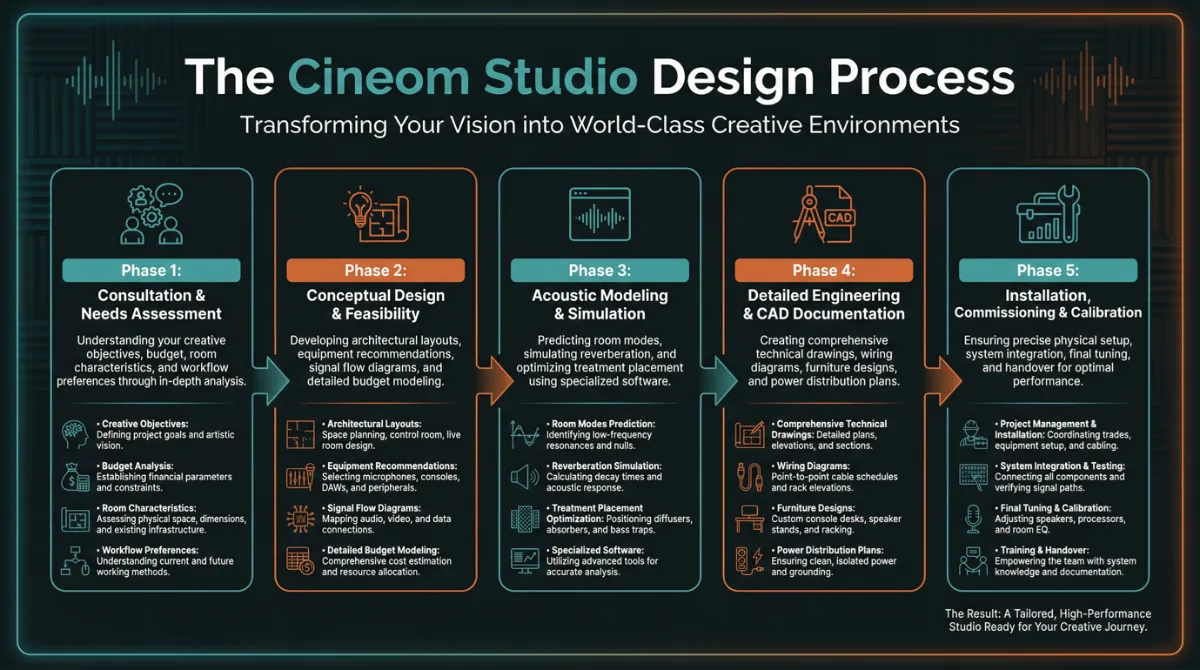
Here’s what the journey typically looks like:
Phase 1: Consultation & Needs Assessment
The foundation of any successful design is understanding.
We begin with in-depth consultations exploring:
- Creative objectives: What content will you produce? Music genres? Film? Broadcast? Immersive audio? This determines fundamental design priorities.
- Operational scope: How many simultaneous sessions? Client-facing or private facility? Need for isolation between spaces? These questions shape the architectural layout.
- Budget parameters: What’s realistic for both initial build and ongoing operations? We’re frank about costs and help prioritise investments for maximum impact.
- Room characteristics: Detailed analysis of your physical space—dimensions, ceiling height, structural materials, HVAC systems, neighbouring spaces, ambient noise levels.
- Existing equipment: What do you already own? What should be integrated versus replaced? We maximise the value of existing investments wherever possible.
- Workflow preferences: Are you committed to specific brands or methodologies? Analog purist or digital native? Collaborative or solitary work style? These preferences fundamentally influence system design.
- Timeline: When must the facility be operational? Are there immovable deadlines (content releases, lease obligations) driving the schedule?
This phase typically involves multiple conversations, site visits, acoustic measurements using specialised equipment (gathering baseline noise floor, RT60 measurements, and frequency response characteristics), and collaborative document development outlining project scope.
Phase 2: Conceptual Design & Feasibility Study
Armed with a comprehensive understanding of your needs, we develop initial design concepts.
This includes:
- Architectural layouts: Floor plans showing room dimensions, furniture placement, equipment positioning, traffic flow, and sightlines
- Equipment recommendations: Preliminary component lists with alternatives at various price points, allowing budget flexibility while maintaining performance standards
- Acoustic treatment strategies: Initial calculations of absorption/diffusion requirements, bass trap placement, and isolation specifications
- Signal flow diagrams: High-level overview of how audio and video signals move through the facility
- Budget modelling: Detailed cost projections broken down by category (construction, acoustics, equipment, installation, calibration) with contingency allocations
- Timeline projections: Realistic schedules accounting for procurement lead times, construction phases, and commissioning
This phase is highly iterative. We present concepts, gather your feedback, refine approaches, and continue this collaborative cycle until the design genuinely reflects your vision and constraints. Nothing proceeds to the next phase until you’re confident we’re on the right track.
Phase 3: Acoustic Modelling & Simulation
Before any physical work begins, we validate acoustic performance through sophisticated modelling.
- Using specialised software (tools like EASE, CATT-Acoustic, or FIRmeasure), we:
- Predict room modes: Identify problematic resonant frequencies and calculate treatment requirements to manage them
- Simulate reverberation characteristics: Model how RT60 will vary across the frequency spectrum based on proposed treatment schemes
- Analyse speaker coverage: Ensure monitoring provides an even frequency response across the listening area
- Optimise treatment placement: Determine exactly where absorption and diffusion provide maximum benefit
- Model HVAC noise: Predict ambient noise floor and verify it meets target NC (Noise Criteria) ratings
This virtual testing allows us to solve problems before construction begins—far less expensive than discovering acoustic deficiencies after walls are built and speakers are hung. We can test multiple treatment scenarios, compare approaches, and optimize the design for both performance and budget.
Phase 4: Detailed Engineering & CAD Documentation
With acoustics validated, we develop comprehensive technical documentation guiding the build.
This includes:
- Architectural CAD drawings: Precise construction documents showing wall assemblies, door specifications, HVAC integration, and lighting plans
- Wiring diagrams: Complete cable schedules showing every signal path, connector type, and routing strategy (often hundreds of connections in complex facilities)
- Furniture design: Custom technical furniture engineered for ergonomics, equipment access, and cable management
- Acoustic treatment drawings: Exact specifications for panel construction, placement coordinates, mounting methods, and material specifications
- Power distribution plans: Electrical infrastructure ensuring adequate, clean power for all equipment with appropriate grounding schemes preventing hum and interference
- Equipment rack elevations: Detailed layouts showing component placement in racks for optimal signal flow and heat management
- Network architecture: For facilities requiring networked audio (Dante, AVB, MADI), comprehensive network diagrams ensuring proper bandwidth allocation and redundancy
This documentation serves multiple purposes: guiding contractors during construction, serving as a roadmap during installation, and providing permanent reference materials for future maintenance and expansion.
Phase 5: System Integration & Installation
Now the physical work begins.
Our installation teams bring designs to reality:
- Acoustic construction supervision: We either perform or closely oversee the installation of acoustic treatment, ensuring materials are correctly installed and performance meets specifications
- Equipment installation: Precise mounting of speakers, racks, consoles, and all system components according to engineering specifications
- Cable routing: Methodical, labelled cabling following best practices for organisation, serviceability, and electromagnetic interference prevention
- System assembly: Building complex signal paths, programming routing matrices, and configuring network audio systems
- Quality control: Testing every connection, verifying signal paths, checking for ground loops or interference
Depending on project scope, this phase can range from weeks to months. Throughout this period, we maintain regular communication, providing progress updates and addressing any field conditions that require design adaptations.
Phase 6: Calibration & Commissioning
- Installation completion is only the beginning—precise calibration makes the difference between good and great.
- Our commissioning process includes:
- Speaker measurement and alignment: Using measurement microphones and acoustic analysis software (Smaart, Room EQ Wizard), we measure frequency response at the mix position and optimise speaker placement, delays, and levels for flat response and accurate imaging
- RT60 verification: Confirming reverberation times match design specifications across the frequency spectrum
- System gain structure: Setting optimal levels throughout the signal chain, maximising signal-to-noise ratio while preventing clipping
- Monitor controller calibration: Programming level references, speaker switching, and monitoring options
- Immersive audio configuration: For Atmos facilities, precise level matching, time alignment, and object placement verification across all channels
- Power and grounding verification: Confirming no hum, buzz, or electromagnetic interference corrupts audio quality
- Video calibration: For facilities with reference displays, professional colour calibration ensures accurate picture monitoring
- Documentation: Capturing all calibration settings, creating recall sheets, and providing system diagrams
This is meticulous work requiring specialised equipment and trained ears, but it’s what transforms a collection of components into a cohesive, trustworthy monitoring environment.
Phase 7: Training & Support
- Even the most intuitive system requires familiarisation.
- We provide comprehensive training covering:
- Basic operations: Daily workflows, powering up/down sequences, and routine session tasks
- Advanced features: Routing matrices, automation systems, immersive audio workflows, and specialised functions
- Troubleshooting: How to diagnose common issues, when to call support, and basic maintenance procedures
- Best practices: Signal flow concepts, gain staging, file management, and backup protocols
Training is tailored to the team’s experience level—experienced engineers need different support than facility owners learning audio fundamentals. We offer hands-on training at your facility, documentation packages, and video tutorials for ongoing reference.
Our relationship doesn’t end at commissioning. We provide ongoing technical support, are available for system expansions or modifications, and maintain long-term relationships with clients. Studios evolve; we’re here to ensure your facility evolves successfully.
Why Choose a Professional System Integrator Like Cineom?
The DIY approach is tempting. With enough forum reading and YouTube tutorials, it seems possible to design and build your own studio, potentially saving the cost of professional integration.
Here’s the uncomfortable truth: that approach almost always costs more in the long run.
Avoiding Costly Mistakes
A single poor decision—wrong monitor choice, inadequate bass trapping, improper console grounding, insufficient headroom in power distribution—can require expensive remediation. We’ve been called to “rescue” many DIY projects where clients had already spent their budget on equipment but achieved mediocre results. Retrofitting proper acoustics, replacing incompatible equipment, and redesigning workflows typically costs 1.5-2x what proper initial design would have.
Professional system integrators prevent these expensive mistakes through experience. We’ve seen what works and what fails across hundreds of projects. That institutional knowledge is invaluable.
Time Savings & Project Management
Coordinating a studio build is a full-time job requiring expertise across multiple disciplines: architecture, acoustics, electrical, networking, equipment integration, and calibration. Trying to manage this while simultaneously running your creative business is overwhelming.
Cineom serves as your single point of contact, coordinating contractors, managing schedules, ensuring quality control, and troubleshooting issues. This project management expertise alone often justifies integration costs—the time saved can be redirected toward revenue-generating activities.
Optimized Performance
There’s a massive difference between “working” and “optimised.”
Your studio might function—audio comes out of speakers, Pro Tools records—but is it achieving its full potential? Are you hearing accurate low frequencies? Is your Atmos imaging precise? Is the workflow as efficient as it could be?
Optimisation requires specialised measurement equipment, trained ears, and extensive experience. This is where professional calibration and commissioning create dramatic performance improvements that DIY builders simply cannot achieve.
Future-Proofing & Scalability
Technology evolves rapidly. Immersive audio formats emerge, network protocols advance, and equipment capabilities expand. Professional system designs anticipate future growth, building in expandability and upgrade paths from the beginning.
We design infrastructure—power capacity, cable runs, rack space, network bandwidth—with headroom for expansion. When you want to add Atmos height speakers in two years or integrate a new console in five, properly designed facilities accommodate these changes with minimal disruption and cost.
Peace of Mind
Perhaps most valuable: the confidence that your facility will work as promised.
When opening day arrives—when clients are booked, deadlines loom, and expectations are high—you need systems that function flawlessly. Professional integration provides that confidence. If issues arise, you have expert support only a phone call away. That peace of mind is priceless during the stressful early days of facility operation.
Ready to Transform Your Vision Into Reality?
Every legendary studio began as a concept—a vision of what could be.
The difference between concepts that remain dreams and concepts that become inspiring realities often comes down to expertise, methodology, and attention to detail. That’s precisely what Cineom Broadcast FZCO brings to every project.
Whether you’re envisioning:
- An intimate music production studio that captures organic performances with analog warmth
- A cutting-edge Dolby Atmos mixing theater for theatrical post-production
- A multi-room broadcast facility handling live programming and content production
- A hybrid production environment blending music, post-production, and podcast recording
- An educational facility training the next generation of audio professionals
- Or something entirely unique that doesn’t fit conventional categories
- …We have the expertise, partnerships, and proven methodology to bring that vision to life.
Let’s Start the Conversation
The journey from concept to console begins with a single step: reaching out to our team.
We invite you to contact Cineom Broadcast FZCO for a personalised, no-obligation consultation. During this conversation, we’ll:
- Explore your creative vision and operational objectives
- Discuss your space, timeline, and budget parameters
- Share relevant case studies from similar projects we’ve designed
- Outline potential approaches and next steps
- Answer any questions about our process, capabilities, or philosophy
This consultation is entirely pressure-free—our goal is to understand whether we’re the right fit for your needs and to provide value even if you decide to proceed differently.
Contact Cineom Broadcast FZCO
Our team typically responds within 24 hours. We’re excited to learn about your project and explore how Cineom’s expertise can translate your creative vision into life as an acoustically perfect, workflow-optimised reality.
Engineering the Art of Media
This is more than a tagline—it’s our philosophy.
Media creation sits at the intersection of artistry and engineering, creativity and technology, inspiration and infrastructure. The facilities that best serve this creative process are those designed with equal respect for both dimensions.
That’s the Cineom approach: honouring the art while mastering the engineering. Creating spaces that inspire while providing tools that enable. Designing flexibility into systems while maintaining operational simplicity. Building for today’s requirements while anticipating tomorrow’s possibilities.
From concept to console, from initial sketches to final calibration, from modest dubbing suites to expansive Dolby Atmos theatres, Cineom Broadcast FZCO engineers the environments where great media is created.
Your dream studio is possible. The technology exists, the knowledge is available, and the team is ready.
Let’s build it together