
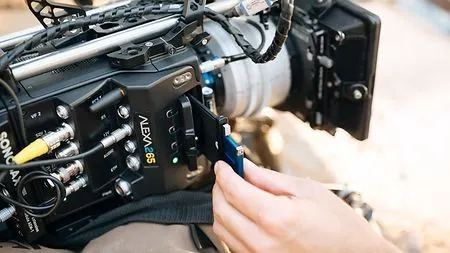
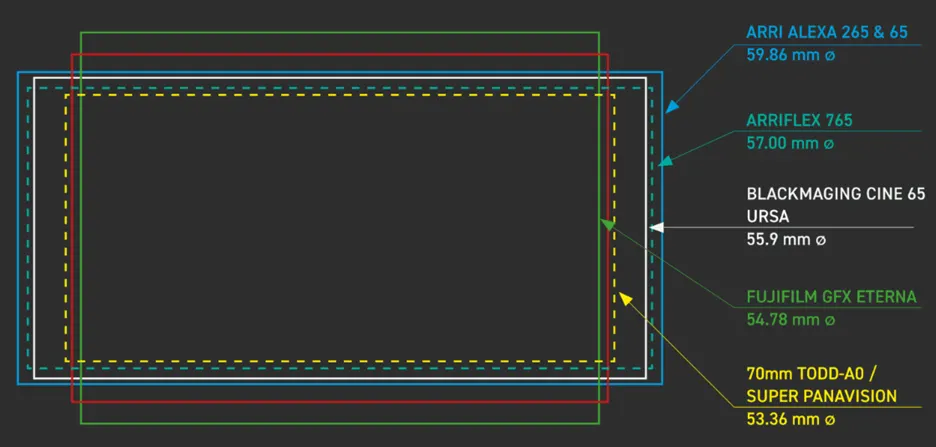
We are seeing a significant shift toward 65mm cinema acquisition this year. Several manufacturers have accelerated this trend by introducing next-generation large-format and ultra-large-format systems. ARRI recently announced the ALEXA 65 Evolution (ALEXA 265) with image circle of 59.86mm, featuring redesigned electronics, enhanced image-processing pipelines, and improved thermal management. Unlike earlier ALEXA 65 models that were exclusive to ARRI Rental, the new system is designed to be more user-friendly and commercially available, enabling local rental houses worldwide to support high-end productions without relying solely on ARRI’s global rental network.
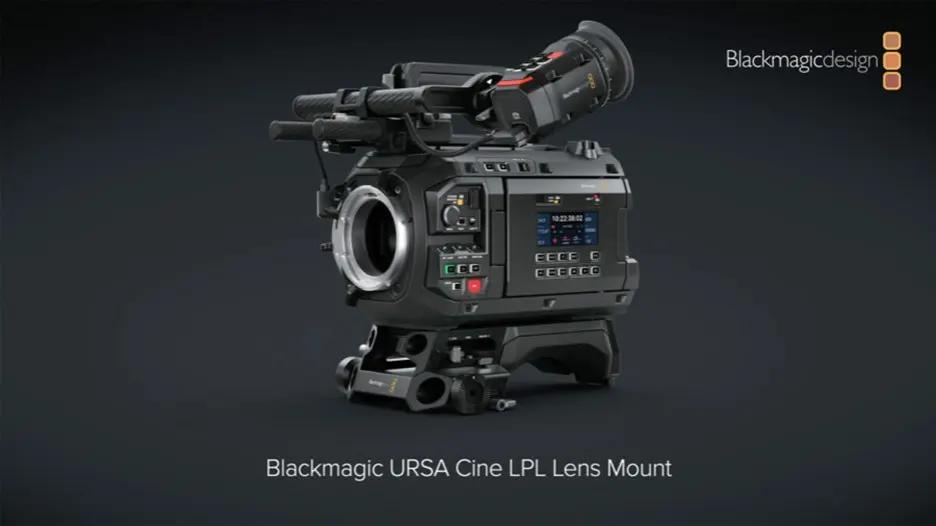
Blackmagic Design also entered the 65mm space with the launch of the Blackmagic URSA Cine 17K with image circle of 55.9mm, offering a massive 65mm-class sensor with 17K open-gate resolution and advanced color science. Similarly, Fujifilm introduced the GFX Eterna 55 with image circle of 54.78mm, featuring a sensor larger than traditional large-format / full-frame standards, positioned to meet the increasing demand for ultra-large-format cinematography.
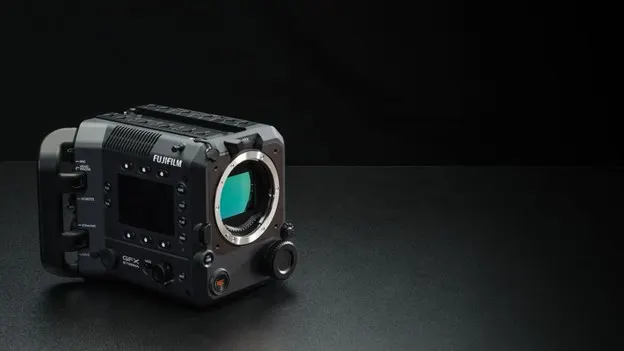
This shift echoes the transition we witnessed when large-format cameras first emerged. At the time, the industry questioned whether lenses with sufficiently large image circles would be available and whether post-production workflows could handle the heavier data rates, larger file sizes, and increased dynamic range requirements. Over time, the ecosystem adapted — and today large-format is widely accepted. We expect a similar evolution for 65mm cinema, with demand increasing for top-tier productions seeking greater detail, dimensionality, and immersive depth rendition.
While many 65mm-capable lenses on the market are rehoused photo optics or smaller image circle lenses with expander, they often suffer from inconsistencies:
- Slow T-Stop
- Poor close focus
- Mismatched focal lengths
- Variations in optical batches
- Uneven color transmission
- Image characteristics that do not hold up across an entire set
- In case of lenses with an expander, for one, it makes the lenses slower, it changes the characteristics and the performance of the lenses
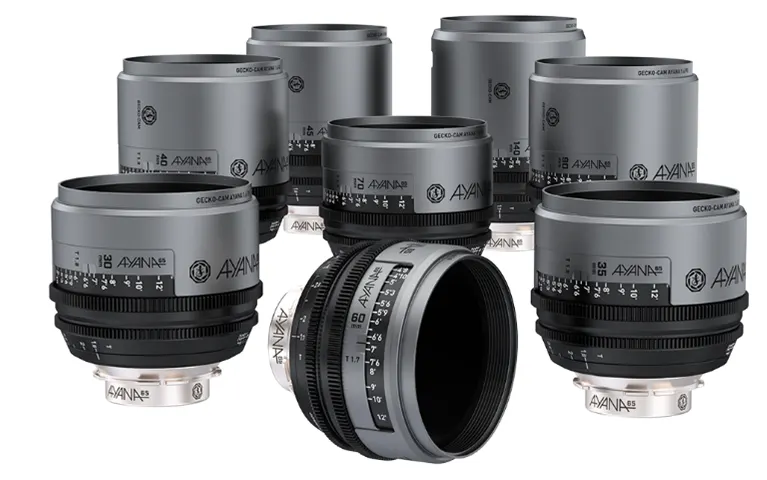
In contrast, we recently evaluated a new development from Germany: Gecko-Cam’s AYANA 65 Cine Lens series, which are developed, manufactured and assembled inhouse at Gecko-Cam in Germany. Unlike rehoused/expander solutions, AYANA lenses are designed from scratch with purpose-built optical formulas and with consistent look throughout the set. They achieve exceptionally fast apertures of T1.7 and T1.8, while covering a 65mm+ image circle and outstanding close focus, making them highly future-proof for upcoming large sensor formats. Although the lenses feature spherical optical designs, they exhibit an anamorphic-like character in 65mm mode — offering pleasing depth compression, unique fall off and textural nuance. The coating of Ayana 65 is optimized for consistent color temperature and natural skin tones.
Another benefit of Ayana 65 is, they are multi format lenses, as they work as well on full frame and Super 35 cameras.
Through extensive testing across the Middle East and India with renowned Directors of Photography, the feedback has been overwhelmingly positive. DOPs appreciated the lenses’ optical consistency, color neutrality, contrast rolloff and large-format cinematic presence. This reinforces the momentum we are seeing: 65mm cinematography is no longer a niche — it is rapidly becoming the next frontier in high-end filmmaking.