
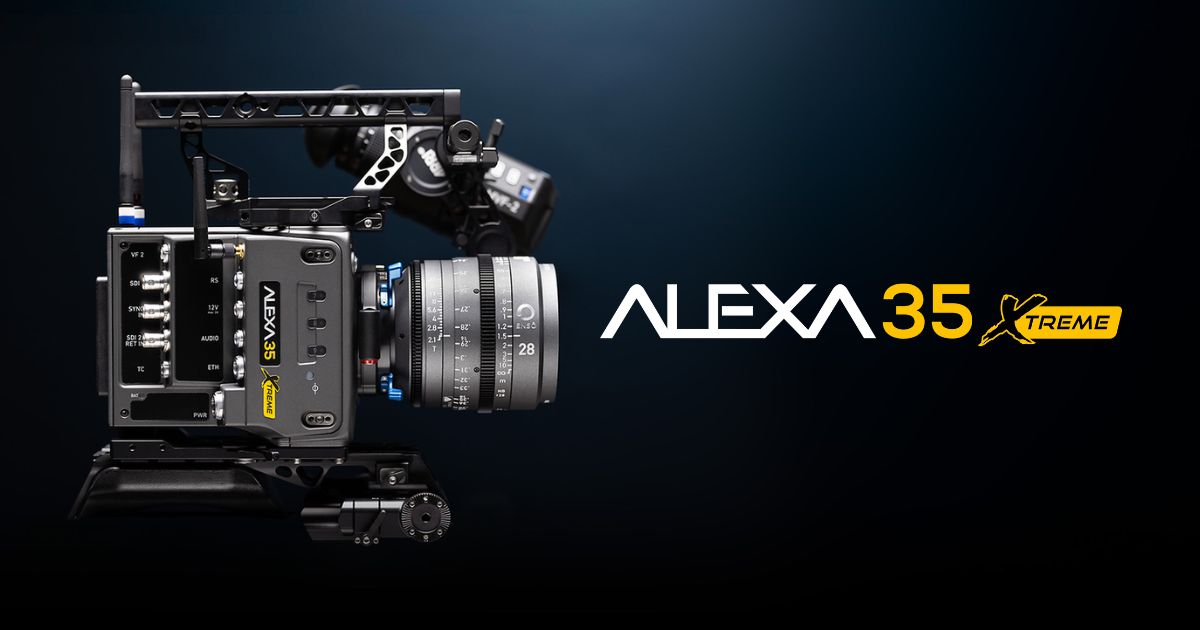
The ALEXA line earned its reputation by making difficult lighting feel forgiving and by turning fast-paced sets into calm, repeatable routines. The ALEXA 35 Xtreme keeps that familiar foundation, then pushes hard in two directions that crews regularly ask for: higher speed capture that still looks like an A-camera, and a modern recording option that eases data pressure without giving up grading authority.
It is not a reinvention of what “an Alexa image” means. It is a clear statement that top-tier picture quality and high frame rates do not have to live on separate bodies.
What the “Xtreme” update really adds
At its core, the ALEXA 35 Xtreme is built around ARRI’s 4.6K Super 35 ALEV4 sensor and the REVEAL image pipeline. If you already trust the ALEXA 35 for highlight handling, colour separation, and skin tone behaviour, you are starting from a known place.
The changes are targeted and practical: a faster processing platform, a high-speed Sensor Overdrive mode, much longer pre-record, and ARRICORE, a new codec designed to cut file sizes while keeping creative controls open.
These updates tend to matter most when a production is trying to keep a single camera ecosystem for an entire show, including beauty work, action inserts, and real-time capture, which you cannot call “reset.”
The image: dynamic range that buys you options, not excuses
ARRI quotes up to 17 stops of dynamic range at normal frame rates on this sensor. Numbers alone do not explain why DPs keep returning to the platform, though. The more meaningful experience is how quickly you can arrive at a “printable” exposure that still protects windows, specular highlights, and practicals while holding texture in darker materials.
That behavior is not only about saving mistakes. It is also about lighting style. With wide latitude, you can choose bolder contrast ratios and still keep a graceful shoulder, or you can work softly and preserve delicate separations in near-white tones that often collapse on other systems.
The camera’s Enhanced Sensitivity mode stretches usable exposure indexes across a broad range (EI 160 to 6400). Clean high EI performance is valuable even on well-lit sets, because it lets you make intentional tradeoffs: smaller fixtures, faster company moves, or deeper stop without pushing noise into a brittle place.
After a paragraph of spec talk, it helps to name the creative outcomes crews usually notice first:
- Smooth highlight roll-off
- Deep shadow detail
- Naturalistic skin tones
- Stable color across exposure shifts
REVEAL, LogC4, and the “textures” approach to a film-forward image
REVEAL is ARRI’s current image pipeline, and LogC4 is its log encoding for modern grading pipelines. The pairing matters because it keeps the camera’s look coherent across formats, whether you are recording ARRIRAW, ARRICORE, or ProRes. That consistency is one reason ALEXA cameras are often chosen as the reference point on multi-camera jobs.
Then there is ARRI Textures, which is a different kind of tool than a LUT. A LUT tends to be a viewing transform or a look decision. Textures are closer to choosing the personality of the image itself: subtle shifts in grain-like structure, contrast response, and the way fine detail “sits” in the frame.
Used well, Textures can reduce the temptation to over-process in post just to get back to something organic. You can set a base character on set that already feels intentional, then keep grading focused on story and continuity.
A simple on-set discipline helps: pick a Texture early, test it on faces and fabrics under your key lighting style, and keep it stable unless the story genuinely calls for a shift.
Speed without switching personalities: 330 fps and the Overdrive option
High-speed footage often becomes a matching problem. Different camera, different sensor, different colour, different highlight behaviour, different noise. The ALEXA 35 Xtreme is designed to remove that friction.
It can reach up to 330 fps at 4.6K while maintaining its full dynamic range, and it can go higher with Sensor Overdrive, reaching up to 660 fps at 2K. Overdrive is an explicit trade: you prioritize speed by reducing dynamic range to roughly 11 stops. That is still usable for many sequences, yet it changes how you should light.
A practical way to think about it is simple: normal mode for anything with complex highlights, bright skies, or a wide contrast range; Overdrive for controlled lighting setups where frame rate is the priority and exposure can be tightly managed.
The other quiet win for unpredictable moments is pre-recording. The Xtreme platform offers dramatically longer pre-roll than many cinema cameras, which can be a genuine advantage for documentary, wildlife, and sports style capture, where the best moment often happens before the operator fully commits to “record.”
ARRICORE: smaller files, fewer compromises
ARRIRAW remains the gold standard when you want maximum flexibility, VFX headroom, and the most robust negative possible. The challenge is that uncompressed or lightly compressed raw comes with real costs: media, offload time, storage, and the human overhead of managing it all safely.
ARRICORE is ARRI’s answer to that pressure. It records a processed RGB image while preserving a 16-bit LogC4 tonal pipeline, with data rates roughly half of ARRIRAW. The point is not only “smaller files.” The point is that key creative parameters remain adjustable in post, including exposure index, white balance, and tint, without the feeling that you have locked yourself into a baked look.
If your editorial team wants to cut directly with camera originals, that matters. If your finishing team needs strong grading latitude, that also matters.
A quick way to frame when each option tends to shine:
- ARRIRAW: maximum negative, heavy VFX, long-tail archiving confidence
- ARRICORE: high-end latitude with more comfortable data rates and editorial readiness
- ProRes: fast turnaround, lighter finishing, predictable pipelines
Built for sets, not spec sheets: ND, monitoring, power, and remote control
Cinema cameras earn loyalty through repetition: the way menus behave at 5 a.m., the reliability of connectors, the speed of exposure changes, and the monitoring flexibility when multiple departments need clean feeds.
The ALEXA 35 Xtreme carries forward the ALEXA 35 body design and accessory compatibility, which is not glamorous but is meaningful. Rental inventories, existing rigs, and operator muscle memory all translate directly.
Key set-friendly details include the internal motorized ND system and robust monitoring I/O. The four-position ND wheel (clear, 0.6, 1.2, 1.8) is a strong baseline for exterior control and for fast lens changes when you want to keep shutter angle and aperture consistent. Dual 12G-SDI outputs support high-quality monitoring paths, and the MVF-2 ecosystem stays in familiar territory for operators and assistants.
Wireless improvements, including 5 GHz Wi‑Fi with roaming and auto-reconnect behavior, support modern on-set control habits, especially when a camera lives on a crane, a vehicle rig, or a stabilized head.
Here are a few operational benefits that tend to show up in daily call sheets:
- Fewer exposure interruptions: internal ND keeps momentum during blocking and coverage
- Cleaner multi-feed monitoring: strong SDI options for operator, DIT, and video village
- More predictable handheld time: modest power improvements can stretch battery rhythm
How it compares in a mixed-camera ecosystem
Many productions build packages around a primary camera choice, then fill specialty roles with smaller bodies. Others plan for a multi-camera finish from the start. Either way, it helps to compare the ALEXA 35 Xtreme by what it prioritizes: latitude, color behavior, and speed while holding a consistent look.
The table below frames a few common decision points against other popular cinema options.
| Category | ALEXA 35 Xtreme | RED Komodo 6K | Sony VENICE (family) | Canon Cinema EOS (C500 II / C700) |
| Sensor format | Super 35 | Super 35 | Full-frame options | Full-frame options |
| “Signature” strength | Highlight behavior + color consistency | Compact global shutter capture | Full-frame look + strong raw ecosystem | Practical ergonomics + pleasing color |
| Dynamic range (claimed/typical) | Up to 17 stops at normal rates | 16+ stops (manufacturer claim) | Often cited around mid-teens | Often cited around mid-teens |
| Built-in ND | Yes, 4-position wheel | No | Yes (electronic ND system) | Yes (varies by model, often deep ND range) |
| High frame rate direction | 330 fps at 4.6K, up to 660 fps at 2K with Overdrive | Modest high speed relative to Xtreme | Strong options depending on model/licenses | Strong but model-dependent |
| Recording philosophy | ARRIRAW plus ARRICORE plus ProRes | R3D workflow | X-OCN / RAW workflows plus internal codecs | Cinema RAW Light plus edit-friendly internal codecs |
None of these cameras are “better” in all circumstances. The ALEXA 35 Xtreme simply aims at a very specific ideal: the same camera can cover your hero dialogue, your high-speed inserts, and your unpredictable moments, and it all remains cohesive in color and tone.
Who benefits most from the ALEXA 35 Xtreme mindset
The most compelling use case is not just high-budget production. It is a production that values consistency over novelty and wants to spend time on lighting, performance, and camera movement rather than on constant technical negotiation.
If you routinely shoot action beats, stunts, liquids, hair, fabric motion, or sports style moments, the high frame rates are an obvious value. If you shoot a documentary or any scenario where the “real moment” arrives without warning, extended pre-recording can become a defining feature, not a nice-to-have.
Then ARRICORE rounds out the picture: it supports the kind of footage volume that high-speed capture can generate, while keeping the post pipeline focused on creative decisions instead of file triage.
The ALEXA 35 Xtreme is a camera built for ambitious coverage: wide latitude when light gets complicated, speed when motion gets dramatic, and recording options that respect how real productions move.